



 +86 18681836350
  info@monokj.com


When engineers design precision components using 301 stainless steel strip, the forming and stamping process often becomes the critical bottleneck between design intent and production reality. Unlike mild steel or aluminum, SS 301 strip behaves uniquely during cold working due to its rapid work-hardening characteristics. Understanding these behaviors—and designing your tooling and processes around them—is what separates successful production runs from rejected batches.
This guide provides practical, shop-floor-level insights into 301 stainless steel strip forming, covering stamping, bending, deep drawing, springback management, and tool wear considerations. Whether you are producing battery clips, spring contacts, or automotive retainers, these techniques will help you optimize your process and reduce scrap rates.
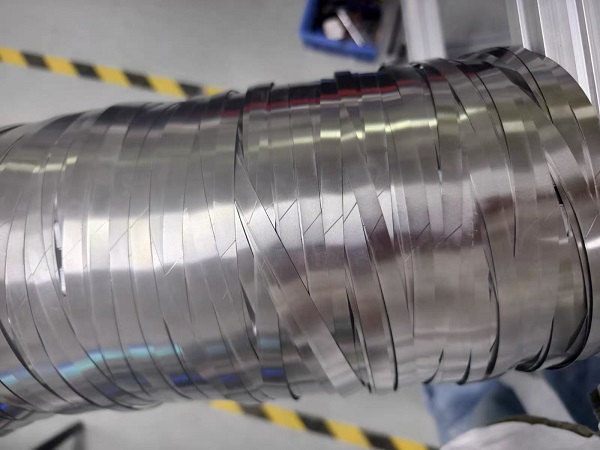
The defining characteristic of AISI 301 stainless steel strip is its ability to increase strength dramatically through cold deformation. During forming, the austenitic microstructure undergoes a partial transformation to martensite. This phase change is not gradual—it accelerates as deformation increases, meaning that the material gets progressively stronger and harder to form the more you work it.
For manufacturers, this creates both opportunities and challenges:
· Opportunity: You can form parts in a softer annealed 301 stainless steel strip temper and let the forming process itself increase strength. This eliminates the need for post-forming heat treatment in many applications.
· Challenge: Excessive work hardening in a single forming step can cause cracking, wrinkling, or springback beyond acceptable tolerances.
In practice, this means multi-stage forming with intermediate annealing is often necessary for complex geometries. A deep-drawn cup or a tightly radiused bend may require two or three forming passes with an annealing step between them. Attempting to achieve the full deformation in one hit will almost always result in splits at the bend radius or thinning below specification.
301 stainless steel strip stamping is widely used for producing connectors, clips, brackets, and small structural components. However, stampers transitioning from mild steel or even 304 stainless steel often underestimate how aggressively 301 work-hardens during shearing and blanking.
For cold rolled 301 stainless steel strip, the recommended punch-to-die clearance is typically 8% to 12% of the material thickness per side. This is slightly higher than the 5% to 8% used for mild steel. The reason is simple: 301 generates more heat and friction at the shear zone, and insufficient clearance causes excessive tool wear and burr formation.
If you are stamping full hard 301 stainless steel strip, increase the clearance toward the upper end of this range (10% to 12%). The higher hardness and tensile strength (up to 1850 MPa) create greater cutting resistance, and tight clearances will rapidly degrade punch edges.
Stamping 301 spring steel strip in full hard or extra hard temper demands premium tool steels. D2 (AISI D2) is the minimum acceptable grade for short runs. For production volumes exceeding 50,000 strokes, consider powder metallurgy tool steels such as ASP 2023 or CPM 10V. These materials retain edge sharpness under the abrasive conditions created by work-hardened 301 strip.
Coating punches and dies with titanium nitride (TiN) or titanium carbonitride (TiCN) can extend tool life by 30% to 50% when stamping precision stainless steel strip 301. However, coatings are not a substitute for proper tool steel selection—they are an enhancement.
In progressive die applications using 301 stainless steel strip coil, carrier strip design becomes critical. Because 301 hardens quickly, the carrier must be robust enough to transfer parts through multiple stations without tearing. A common mistake is designing carriers based on mild steel rules, resulting in stripped carriers and mis-fed parts after the first forming station.
Recommended carrier width for 301 stainless steel strip for stamping parts is 1.5 to 2 times the material thickness, with generous radii at carrier tabs. If the strip is full hard temper, increase this to 2.5 times thickness.
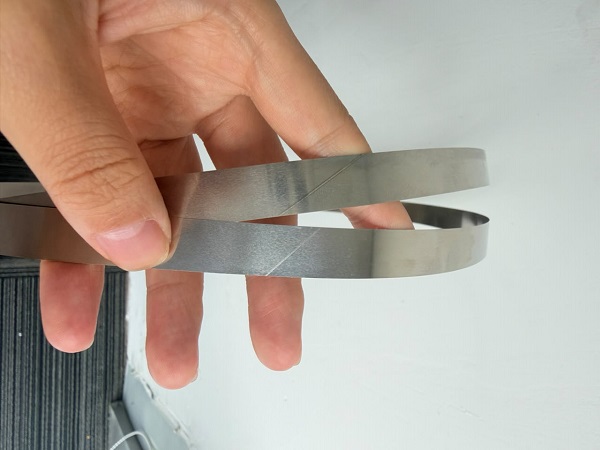
Springback is the nemesis of every precision bender, and 301 stainless steel strip delivers more of it than almost any other common material. In full hard temper, springback angles can reach 15 to 25 degrees after a 90-degree bend. Even in half hard condition, expect 8 to 12 degrees of springback.
The minimum inside bend radius for 301 stainless steel strip bending depends heavily on temper and grain direction:
Temper | Minimum Bend Radius (Longitudinal) | Minimum Bend Radius (Transverse) |
Annealed | 0.5 × thickness | 1.0 × thickness |
Quarter Hard | 1.0 × thickness | 1.5 × thickness |
Half Hard | 1.5 × thickness | 2.0 × thickness |
Full Hard | 2.5 × thickness | 3.5 × thickness |
Extra Hard | 4.0 × thickness | 5.0 × thickness |
Bending with the grain (longitudinal direction) always allows tighter radii because the elongated grain structure resists cracking better along its length. Transverse bends—especially in hard tempers—require significantly larger radii to avoid edge cracking.
To compensate for springback, overbending is the standard technique. For half hard 301 stainless steel strip, overbend by approximately 10 to 15 degrees beyond the target angle. For full hard 301 strip, overbends of 20 to 30 degrees are common.
Bottoming (coining the bend) is another effective method for reducing springback in 301 stainless steel strip forming. By applying high pressure at the bottom of the bend stroke, the material is plastically deformed into the die corner, effectively "setting" the angle. Bottoming forces for 301 are roughly 3 to 5 times those required for mild steel, so press capacity must be verified before attempting this approach.
For long-radius bends and continuous profiles, 301 stainless steel strip responds well to rotary bending and three-roll forming. The gradual nature of these processes distributes work hardening more evenly, reducing the risk of localized cracking. However, because the material strengthens continuously, forming forces increase as the bend progresses. Operators must monitor for motor overload or roll slip, particularly when forming thin 301 stainless steel strip below 0.3 mm thickness.
For 301 stainless steel strip for battery clips, use half hard to full hard temper. Form in a single bend operation with overbend compensation. The springback actually benefits the final design—it provides the contact force that maintains electrical continuity. Avoid bottoming, as it may reduce the elastic recovery that creates the desired spring force.
301 stainless steel strip for hose clamps is typically supplied in cold rolled, full hard condition at 0.5 mm to 0.8 mm thickness. The forming process involves a series of small-radius bends to create the band profile. Because the material is already at maximum hardness, bend radii must be generous, and tools must be maintained to razor-sharp edges to prevent tearing at the tensioning slot.
301 stainless steel strip for automotive components such as seat belt retractor springs demands precise fatigue life. Forming must not introduce surface defects or edge cracks that could propagate under cyclic loading. Polished tooling surfaces, deburred strip edges, and controlled forming speeds (avoiding impact loading) are essential quality controls.
Forming and stamping 301 stainless steel strip requires a mindset shift from conventional mild steel processing. The material's rapid work hardening, high springback, and tool-wearing characteristics demand intentional process design. By selecting the correct temper for your application, designing tooling with appropriate clearances and radii, and managing springback through overbending or bottoming, you can produce high-quality precision parts at commercially viable costs.
If you need custom width 301 stainless steel strip, precision slit 301 strip, or technical support on forming applications, contact our engineering team. We supply 301 stainless steel strip coil in all tempers from annealed to extra hard, with mill test certificates and full traceability to ASTM A666 and EN 1.4310 standards.