


 +86 18681836350
  info@monokj.com


Modern industries are pivoting towards sustainable solutions, and aluminum alloy is emerging as a critical enabler of this transformation. Its inherent properties directly address today's challenges of energy efficiency and environmental responsibility.
1. Lightweighting for Immediate Carbon Reduction
The primary advantage of aluminum alloy is its exceptional strength-to-weight ratio.
In transportation—from electric vehicles (EVs) to aircraft—this translates directly into reduced energy consumption.
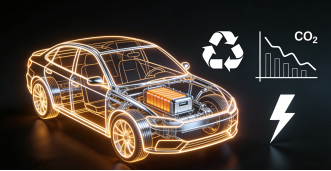
For example, studies show that using aluminum in EVs can significantly extend battery range. Every kilogram saved through aluminum alloy components means lower emissions over the vehicle's lifespan, making it a strategic material for meeting stringent global CO2 targets.
2. The Infinite Lifecycle of a Permanent Material
Unlike many composite materials, aluminum alloy is 100% recyclable without any loss in quality.
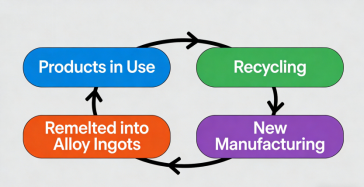
This "circular" characteristic is unmatched. Recycled aluminum requires only about 5% of the energy used for primary production, dramatically lowering its carbon footprint.
This closed-loop potential aligns perfectly with the principles of a circular economy, turning end-of-life products into valuable feedstock for new manufacturing, indefinitely.
3. Innovation in Manufacturing Amplifies Benefits
Advances in processing technology, such as mega-casting, unlock further value.
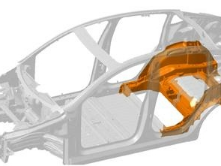
The orange section illustrates its integrated structure.
Pioneered by companies like Tesla, this technique uses high-precision molds to form large, complex vehicle body parts from a single piece of aluminum alloy. It reduces hundreds of parts into one, slashing manufacturing complexity, material waste, and assembly energy.
This innovative application underscores how aluminum alloy is not just a material choice, but a driver for smarter, more efficient production that complements its sustainable credentials.
In summary, aluminum alloy is more than just a versatile metal; it is a foundational material for a sustainable industrial future. By delivering lightweight performance and embracing a truly circular lifecycle, supported by innovative manufacturing, it offers a clear pathway for industries to achieve both economic and environmental goals.